 Indlæser

Powerful Practice: Planning and Implementing Authentic Occupational Therapy Services
Powerful Practice: Planning and Implementing Authentic Occupational Therapy Services
- occupational therapists are continually challenged by the constraints of practice, education, and research
- occupational therapists long for ownership and pride in the work they do, and
- occupational therapists feel a deep need to practice authentically as occupational therapists while advancing the profession.
- overcome, minimize, or work around the constraints they face in practice;
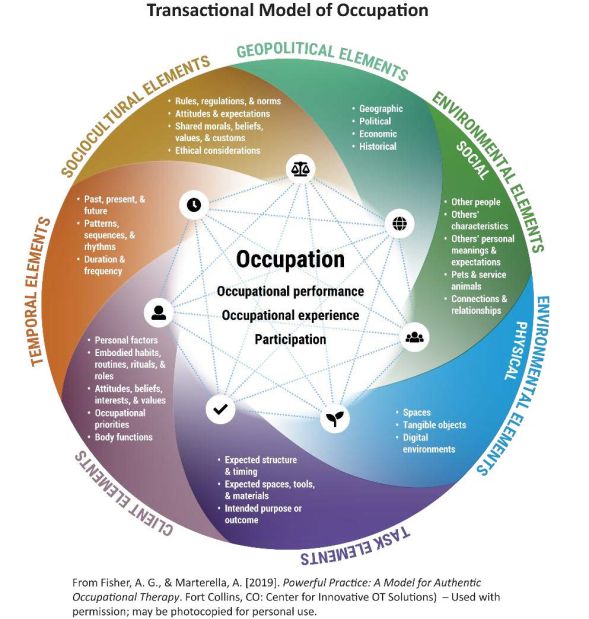
- reason about the complexity of occupation using the Transactional Model of Occupation;
- critique their evaluation and intervention methods and modify them to ensure they better align with authentic occupational therapy;
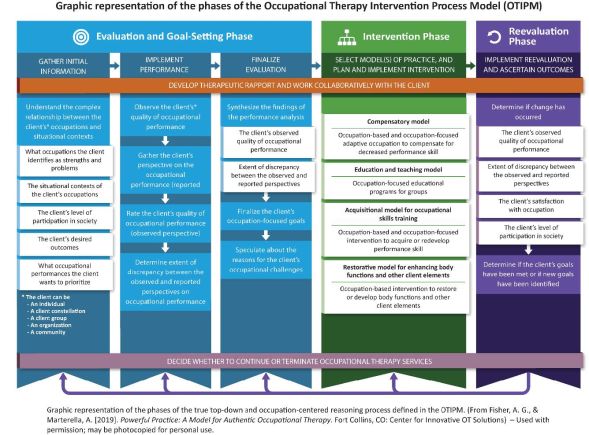
- use the Occupational Therapy Intervention Process Model (OTIPM) to guide the implementation of authentic occupational therapy services;
- implement and rate observation-based performance analyses of their clients’ quality of occupational performance; and
- build practice-based evidence that demonstrates the true power of occupation.
Occupational therapy clinicians, students, educators, and researchers who
- Want a clear reasoning model that helps them organize the many evaluation and intervention options available and decide which to use at different phases of the OT process—making both practice and teaching more effective.
- Are ready to reinvigorate their work by confidently delivering services that are truly occupation-based and occupation-focused.
- Already feel good about their practice but want the chance to reflect, fine-tune, and strengthen what they do—becoming even more occupation-centered while also learning how to better communicate the power of occupation to others.
- Know it’s time for change but aren’t sure where to start—this course offers practical strategies to break through obstacles and move toward the kind of practice they envision.
- conducting standardized, occupation-focused and occupation-based evaluations of the quality of a person’s occupational performance, including social interaction; and
- creating clear, occupation-focused documentation.
At the conclusion of a 3-day OTIPM workshop, the participants will
- Understand the occupation-centered professional reasoning process defined in the OTIPM.
- Distinguish between occupation-centered reasoning and occupation-based and occupation-focused practice.
- Articulate various types of evaluations and interventions occupational therapists commonly use and evaluate which ones are ecologically-relevant, occupation-based, and/or occupation-focused.
- Apply true top-down and occupation-centered reasoning in the context of implementing occupation-based and occupation-focused services.
- Implement standardized observation-based performance analyses of a person’s quality of occupational performance.
- Understand when and how to link other occupational therapy models of practice and evaluation methods into the occupational therapy intervention process.
- Use the Transactional Model of Occupation to reason about the intertwined relationships among various elements of situational contexts and the elements of occupation: occupational performance, occupational experience, and participation.
- Write occupation-focused documentation, including observable and measurable client-centered goals.
- Use systematic strategies for accumulating practice-based evidence of the effectiveness of occupational therapy interventions.
| 8.30 |
Registration and breakfast
|
| 9.00 |
Introduction to the course
Transactional Model of Occupation
|
| 10:15 | Developing a common language A method for critiquing occupational therapy services |
| 10.35 | Break |
| 11:00 | A method for critiquing occupational therapy services |
| 12:30 | Lunch break |
| 13:30 | Legitimate occupational therapy interventions |
| 14:30 | Break |
| 14.55 | Legitimate occupational therapy interventions (cont.) |
| 15:30 - 17:00 |
Introduction to the OTIPM
Evaluation approaches
Case application — Gather initial information |
| 8:00 | Breakfast |
| 8:30 | Case application — Document initial information |
| 9:30 | Case application — Implement performance analysis (observe and rate motor and process skills) |
| 10:30 | Break |
| 10:55 | Case application — Implement performance analysis: Finalize ratings and identify ineffective skills |
| 12:00 | Lunch |
| 13:00 | Case application — Finalize evaluation: “cluster” and document baseline level of performance |
| 14:30 | Break |
| 15:00 - 16.30 | Finalize evaluation: client-centered goals, and speculated reasons for diminished occupational performance |
| 8:00 | Breakfast |
| 8:30 | Case application — Intervention and reevaluation: document intervention plan, reevaluate, and document outcomes |
| 9:00 | Case application — Implement performance analysis: introduction to social interaction skills |
| 10:00 | Break |
| 10:25 | Case application — Implement performance analysis: observe and rate social interaction skills and identify ineffective skills |
| 12:00 | Lunch |
| 13:00 | Case application — Finalize evaluation: “cluster” and document baseline level of performance |
| 14:00 | Case application — Finalize evaluation: client-centered goals, speculated reasons for diminished occupational performance; Intervention, and reevaluation |
| 14:45 | Break |
| 15:10 - 16.30 |
Framing function from a unique occupational therapy perspective.
Implementing changes in practice — Overcoming obstacles and a call to action.
Closing.
|
The Quality of Occupational Performance (QOP) is a suite of three evaluation tools designed for implementing standardized performance analyses:
• QOP: ADL – used to evaluate the quality of a person’s ADL task performances based on the ratings of 16 ADL motor skills and 20 ADL process skills,
• QOP: Schoolwork – used to evaluate the quality of a student’s schoolwork task performance based on the rating of 16 schoolwork motor skills and 20 schoolwork process skills, and
• QOP: Social – used to evaluate the quality of a person’s social interaction based on the ratings of 27 social interaction skills.
Each QOP tool provides a standardized, valid, and reliable method for evaluating the quality of occupational performance. Each is occupation-focused – they focus on occupation itself, the quality of performance of client-prioritized, meaningful tasks that people of all ages need and want to do – not on underlying body functions.
Each QOP tool provides a standardized, valid, and reliable method for evaluating the quality of occupational performance. Each is occupation-focused – they focus on occupation itself, the quality of performance of client-prioritized, meaningful tasks that people of all ages need and want to do – not on underlying body functions.
The extensive research supporting the validity and reliability of these tools provides the psychometric foundation for the validity, reliability, and interpretation of each of the QOP tools. Each QOP tool has associated with it a scoring program that is used to generate adjusted scaled scores (0–100) that can be interpreted from both criterion-referenced and norm referenced perspectives.
A Vision for the Profession
Our goal has been to make these resources freely available to occupational therapists, educators, and students – those who carry forward the heart and purpose of our profession. We seek not only to ensure access, but to empower occupational therapists to illuminate the power of occupation – to enhance the daily life functioning and meaningful participation for all people. As occupational therapy continues to grow across continents, we hope this vision reaches those just beginning their journey – inspiring them to embrace authentic, occupation-centered practice and to bring its transformative potential to life.
Information om arrangementet
Dato og tid Mandag d. 11. maj 2026 kl. 08:30 til onsdag d. 13. maj 2026 kl. 16:30
Tilmeldingsfrist Mandag d. 6. april 2026 kl. 12:00
Sted
Center for Hjerneskade
Amagerfælledvej 56A
2300 København S
Arrangør
Center for Hjerneskade
Tlf. +45 35329006
kontakt@cfh.ku.dk
Find vej til arrangementet
Om Center for Hjerneskade
Vi er en selvejende institution, specialhospital under sundhedslovens §79, stk. 2. Vi udreder, rådgiver og behandler mere end 600 børn, unge og voksne om året.
Tilmelding

Indlæser
Tilmelding
Indlæser
Indlæser
Indlæser
Oplysninger om deltageren
Felter markeret med (Påkrævet) skal udfyldes.
Find vej til arrangementet
Om Center for Hjerneskade
Vi er en selvejende institution, specialhospital under sundhedslovens §79, stk. 2. Vi udreder, rådgiver og behandler mere end 600 børn, unge og voksne om året.